可再生能源上網電價 (住宅客戶)

智慧用電新世代現已啟動,大家都可以出一分力,攜手應對氣候變化。齊來參與嶄新的「可再生能源上網電價」(簡稱上網電價),踏出低碳生活第一步,共建可持續發展的未來。



可再生能源上網電價 (住宅客戶)

Technology in everyday homes has evolved since the start of the decade. Almost every part of the home can be connected to the internet, allowing local or remote control of thermostats, cameras, locks, lights, switches, sensors, and even doggy doors. While smart home devices are abundant, the lack of an industry-wide connectivity standard leaves people confused and frustrated when trying to understand what devices work with each smart home ecosystem. It also places a heavy burden on manufacturers to make sure all devices are compatible with each other.
We’re joining Amazon, Apple and others to create Connected Home over IP, a new independent working group managed by the Zigbee Alliance (separate from the existing Zigbee 3.0/Pro protocol). Our goal is to bring together market-tested technologies to develop a new, open smart home connectivity standard based on Internet Protocol (IP). Google’s use of IP in home products dates back to the launch of Nest Learning Thermostat in 2011. IP also enables end-to-end, private and secure communication among smart devices, mobile apps, and cloud services.
We’re contributing two of our market-tested and open-source smart home technologies, Weave and Thread. Both are built on IP and have been integrated into millions of homes around the world. Weave, an application protocol, works over many networks like Thread, Wi-Fi, Bluetooth Low Energy, and even cellular. Even when devices are on different networks, Weave allows them all to securely work with each other.
Developers and consumers will benefit from this new universal smart home connectivity standard. For developers, it simplifies product development and reduces costs by giving them one standard for building their products. You will then have the power to choose how you want to control your homes, independent of which smart home technology you choose. Smart home devices will be compatible with various platforms, so you can choose between Google Assistant, Amazon Alexa, Apple Siri or other platforms.
We’re excited to partner with the industry on the next stage of growth for the thousands of smart home developers in our Works with Google Assistant program. This project brings us closer to the vision of the helpful home that takes care of the people inside it.

JD.com today announced the launch of China’s first 5G-powered smart logistics park in Beijing, China. China’s largest retailer continually breaks new ground through its own logistics business, JD Logistics, to keep the customer continually at the center. Aligning with its Industrial IoT (IIoT) strategy, the park implements 5G networks at its Asia No. 1 Warehouse in Beijing.
The bandwidth offered by 5G will enable JD to dramatically increase the efficiency of its IIoT fulfilment capacities on a large scale, facilitating instantaneous communication between human employees and smart machines, while enabling holistic monitoring of the site’s operations.
The facility’s newly implemented monitoring system will detect and analyze any problems occurring in the warehouse in real time. The technology will enable real-time monitoring of location and routes for forklifts and pallets, and provide preemptive alerts if something abnormal arises. For example, the technology would enable provision of wrong parking location alerts and abnormal driving route alerts for the forklifts to ensure efficiency and safety. Mass pallet monitoring will significantly increase efficiency improvement over manual monitoring. The 5G system will also greatly improve the efficiency of operations within the facility through smart parking which guides incoming vehicles to the most appropriate parking space or docking bay, and digital docking bay which can do real-time monitoring the truck loading and uploading goods.
These innovations are just the beginning of JD’s plans to utilize 5G technology. In the future, 5G-powered IIoT will drive a range of further applications across JD’s logistics operations, improving efficiency throughout the supply chain.
“The launch of JD’s 5G-powered smart logistics park in Beijing – the first of its kind – is an exciting step in the realization of the Industrial Internet of Things at scale,” said Wenming Zhe, chief architect of logistics R&D, head of 5G-powered smart logistics park projects at JD Logistics. “The low latency, high speed and ability to support a broad spectrum of simultaneous connections provided by 5G networks creates an unprecedented level of real-time connectivity, significantly improving the efficiency of JD’s fulfilment operations, which is key to providing the best customer service in the business.”
JD’s 5G-powered smart logistics park is an important development in the company’s strategy to utilize 5G networks in the application of IIoT technology across the company’s supply chain operations. JD expects to apply 5G and IIoT throughout its network of logistics parks, allowing for reliable and dependable robot-to-robot communication that requires minimal human intervention.
POSTED IN:Technology
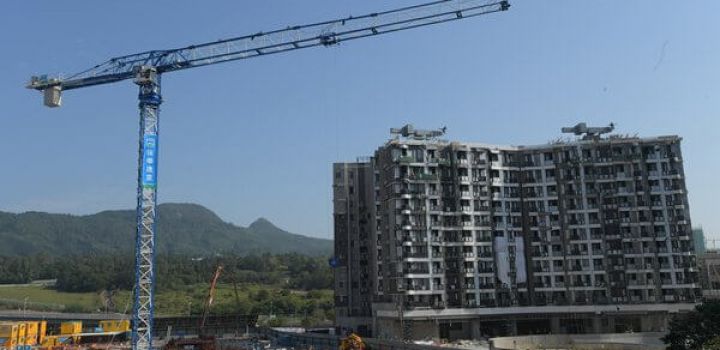
Of the approved plans, 11 were for apartment and apartment-commercial developments, eight were for commercial developments, four were for factory and industrial developments, and six were for community services developments.
Consent was given to start works on 14 building projects, which will provide 328,886 sq m of gross floor area for domestic use involving 5,583 units, and 112,272 sq m for non-domestic use.
The department also issued 36 occupation permits – 12 on Hong Kong Island, seven in Kowloon and 17 in the New Territories.
Buildings certified for occupation have 250,823 sq m of gross floor area for domestic use involving 4,085 units, and 71,745 sq m for non-domestic use.
The declared cost of the new buildings completed in the month was $10 billion.

Design Post is a year-round showroom and platform. We empower brands and design professionals in the interior design industry by giving them the tools, knowledge and networks they need to connect, collaborate and generate business. At Design Post, our aim is simple: to act as a generous catalyst.
About Design Post
In our monumental building in Cologne, Design Post functions as an open network of brands and design professionals in the interior design industry. We empower both brands and established and emerging design professionals with the tools, knowledge and networks they need to connect, collaborate and generate business.
We are proud of our role in initiating many project collaborations through encounters at Design Post. Our ambition is to further strengthen our position as a frontier for the industry – be it as catalyst or moderator.
At Design Post, our aim is simple: to act as a generous catalyst.
Design Post was co-founded by Dutch designer Willem van Ast, the former director of family-owned furniture brand Arco, supported by a knowledgeable team of German experts. From the start, a special culture combining German Gründlichkeit (thoroughness) and Dutch openness has been able to flourish.
Are you interested in becoming a partner? Would you like to present yourself alongside the best companies in the industry?
We look forward to meeting you!
Your contacts:
Volker Streckel
Design Post Manager, since its foundation in 2006

The combined effects of a slowdown in the world economy, machinery production, and capital expenditure will depress growth this year in the global market for industrial automation equipment (IAE), shaving at least 1.5 percentage points of growth when the year ends compared to 2018 levels.
All told, global IAE revenue this year is projected to reach $218.3 billion, IHS Markit estimates. While growth is up 3.2% from 2018 levels, expansion is down from the much stronger 4.7% figure of a year earlier during the 2017-18 period.
These findings are contained in the recently released IHS Markit report, Industrial Automation Equipment Market Tracker Q1 2019, which examines major economic developments, including the impact of oil and commodity pricing on market demand for industrial equipment, while also identifying trends and drivers influencing the industry during the period.
In all, 52 different industrial automation equipment markets are tracked in the three categories of motors, generators, and motor controls; automation equipment; and power and transmission equipment.
Among the major regional IAE markets, China will continue to post the highest growth rate at 5.0%, followed by the Americas at 3.6%, as shown in the graphic below.

Cooling seen in various indicators
Signs of softening could be seen during the period in various indicators pertinent to the global IAE market.
Given how the world economy was performing in the first quarter, real GDP growth, for instance, was projected to decline in 2019 compared to last year’s levels. This is true for the United States—where real GDP growth based on annual averages is projected to decelerate to 2.7%, down from 2.9% in 2018. Real GDP growth in 2019 will also contract in the Eurozone, China, and India.
Growth is likewise slowing in machinery production, another IAE market indicator.
The year started badly, with the Eurozone experiencing the steepest decline among world markets because of worsening conditions caused by slowing world trade and vehicle sales. Widespread worries were also present among manufacturers during that time on growing global trade protectionism, potentially higher tariffs, and unresolved questions relating to Brexit.
In Asia, growth in machinery production was revised downward to less than 1% at the beginning of 2019 following China’s weak performance and headwinds in the shadow of a mounting trade war with the United States. Growth in China is forecast to decline further before the year is over, and as a result, manufacturing has been trending slowly away from China toward Vietnam, Indonesia, and Thailand. India remained a bright spot in Asia, with manufacturing operations there expected to strengthen over the course of 2019.
Machinery production was enjoying its strongest growth in the Americas. Despite major slowdowns in other parts of the world, first-quarter growth in the region was forecast to reach a solid 3.1%. Even so, IHS Markit has become less optimistic about prospects for most industries in the Americas from 2019 to 2021. Growth in manufacturing output is contracting overall, with businesses expected to scale back the accumulation of manufacturing plants and equipment, which would then slow capacity and sales alike.
Slower growth was also projected this year in industrial capital expenditure, another indicator of IAE market prospects. Representing the funds for maintaining, improving, or acquiring assets like buildings, land, machinery, and automation products, industrial capital expenditure in 2019 was expected to grow just 2.2% this year, down from 7.1% in 2018.
Capital expenditure is given a closer look in the report with a more detailed analysis of 11 major sectors, including automotive, cement and glass, chemicals, food and beverage, metal processing, oil and gas, pharmaceuticals, power, pulp and paper, refining and petrochemicals, and water and wastewater.
A 12th sector groups together four industries: mining, rubber and plastic, military and aerospace, and shipbuilding and maritime. The scale of automation used by these industries varies considerably.
More details on this subject can be found in the report, Industrial Automation Equipment Market Tracker Q1 2019. Additional information is available on the IHS Markit Manufacturing Technology research service page.

Lorem ipsum dolor sit amet, consectetur adipiscing elit. Quisque ex augue, imperdiet nec luctus ut, imperdiet sit amet velit. Vestibulum et aliquam eros. Maecenas massa felis, porttitor a nisl pharetra, imperdiet fringilla diam. Maecenas varius rutrum sapien id dictum. In hac habitasse platea dictumst. Donec vehicula porta tincidunt. Quisque dictum mauris mauris, vitae facilisis diam porta eu. Nulla malesuada malesuada vestibulum. Morbi suscipit erat quis tincidunt egestas. Mauris placerat metus mi, quis consectetur dui ultrices vel. Sed tincidunt enim ut pellentesque consequat. Vivamus id massa a urna eleifend porta ac ut dui.
Sed rutrum euismod dui in dictum. Nunc pulvinar turpis eget pulvinar condimentum. Integer sed cursus ligula. Morbi venenatis blandit magna dapibus tristique. Donec gravida facilisis nulla quis eleifend. Cras consectetur imperdiet dictum. Donec in malesuada nibh. In molestie ipsum non pretium mollis. Ut nulla lacus, iaculis at justo in, venenatis porttitor turpis. Cras non aliquam massa. Sed eleifend id magna et euismod. Vivamus a dui ac quam luctus faucibus eget aliquam mi. Sed gravida, metus eu hendrerit semper, turpis tellus tincidunt augue, vitae aliquam ante diam vitae odio. Morbi in lectus vitae ante elementum posuere sagittis luctus quam.